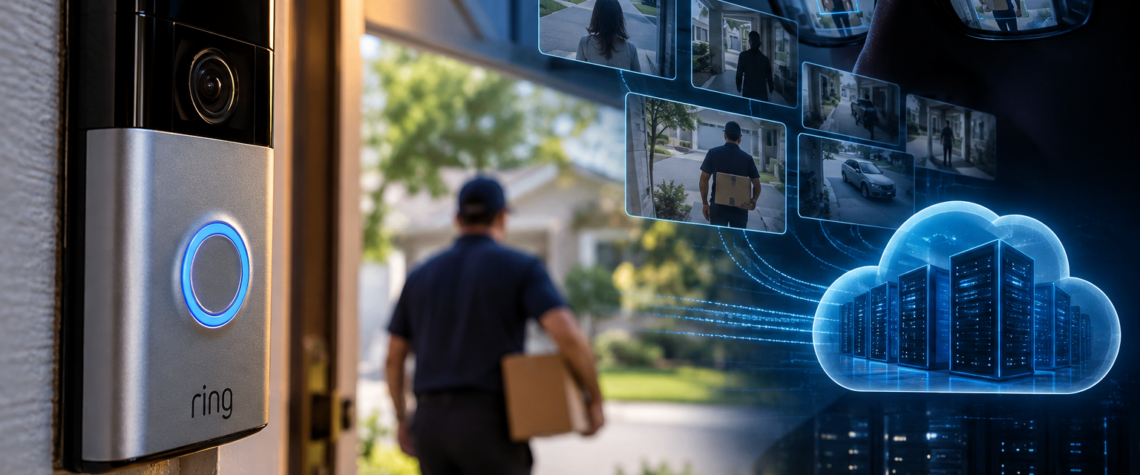
Amazon’s new encryption system promises better protection for Ring camera recordings. But the company can still temporarily access video data to power its smart features.
The camera watching your front door may be getting better at protecting your privacy. But that doesn’t necessarily mean the company behind it can no longer access what it records. Amazon-owned Ring has introduced a new encryption system called TAKE, short for Throw Away the Key Encryption, designed to strengthen the protection of video recordings from its popular smart doorbells and security cameras.
The technology, announced in August 2026 and introduced through a phased rollout beginning in September, promises to give customers greater control over their recordings while preserving the artificial intelligence features that have made smart home security increasingly sophisticated. But there is an important distinction between making video recordings more secure and making them completely inaccessible to the company that operates the cameras. And that distinction matters to anyone who has installed an internet-connected camera outside — or inside — their home.
A New Kind of Digital Key
Encryption works by transforming information into a form that cannot be read without the appropriate digital key. It is one of the fundamental technologies protecting everything from online banking to private messages. Ring’s new TAKE system uses rotating encryption keys to protect recordings. According to Amazon, copies of those keys are temporarily held in a protected cloud environment so Ring can provide features customers have enabled.
The company says these temporary keys are deleted within 24 hours. After deletion, customers retain access through their enrolled devices and recovery methods. That represents an additional layer of protection compared with conventional cloud storage arrangements. But during the period when Ring can use those keys, the company can temporarily decrypt and process video to deliver services such as intelligent alerts and descriptions of recorded events. For example, a Ring camera can distinguish between a person approaching the front door, a delivery vehicle arriving, or a package being left on the porch. Those conveniences depend on analyzing what the camera sees. The question is how much access customers are willing to give a technology company in exchange for those features.
Better Security Is Not the Same as Complete Privacy
Ring describes TAKE as a way to combine stronger encryption with the intelligent functions customers expect. The company also offers a different option: end-to-end encryption. With end-to-end encryption, the keys needed to view recordings remain on the customer’s enrolled devices. Ring cannot decrypt the videos to perform its usual cloud-based processing.
That provides a stronger separation between the customer’s recordings and the company operating the service. There is a trade-off, however. Some cloud-powered features and shared-user functions are unavailable when end-to-end encryption is enabled. TAKE is designed to offer a middle ground: stronger default protection without requiring customers to give up many of the features they already use.
It would be inaccurate to describe TAKE as providing no privacy protection. It introduces meaningful safeguards. But it would be equally misleading to suggest that it offers the same privacy guarantees as end-to-end encryption. The difference comes down to a simple question: who can access the keys, and under what circumstances?
The AI Behind Your Doorbell
The privacy debate surrounding Ring’s new encryption system becomes more significant when artificial intelligence enters the picture. Today’s smart security cameras do considerably more than record visitors approaching a front door. They can analyze video, recognize patterns, identify familiar faces, and even describe events in ordinary language.
Ring’s AI-powered Video Descriptions feature, for example, can generate a written summary of what a camera has recorded. Instead of simply receiving a motion alert, a homeowner might learn that a delivery person left a package on the doorstep or that someone approached the entrance. Another feature, Video Search, allows users to find recorded events by describing what they are looking for. Rather than manually reviewing hours of footage, a homeowner can search for a particular activity.
Ring has also introduced Familiar Faces, a facial recognition feature designed to identify people the user has chosen to register, such as family members or frequent visitors. These capabilities demonstrate how artificial intelligence is transforming home security. Cameras are becoming systems that not only observe the world but also interpret what they see. However, this intelligence comes with an important privacy consideration. Some AI-powered features require Ring’s cloud systems to process video information. That is precisely where the distinction between the company’s new TAKE encryption and traditional end-to-end encryption becomes important.
TAKE allows Ring to retain temporary technical access needed to provide supported cloud features. End-to-end encryption, by contrast, is designed to prevent the company from decrypting customer recordings, but it can also restrict certain intelligent services. The choice facing consumers is therefore more complicated than simply deciding whether their videos should be encrypted.
They must consider how much access to their recordings they are willing to permit in exchange for increasingly sophisticated AI capabilities. A camera that can recognize a family member or describe a stranger’s movements may offer greater convenience and security. But it also raises questions about the collection, processing, and potential use of information about people who appear in its field of view.
As artificial intelligence becomes the brain behind the connected home, consumers need to understand not only what their devices can see, but what those devices—and the companies operating them—can learn.
When Artificial Intelligence Enters the Home
The privacy debate becomes more significant as security cameras gain increasingly sophisticated artificial intelligence capabilities. A traditional camera records images. An AI-powered camera can interpret them, identify objects, describe activities, and help users search through events. These capabilities can make home security more useful. They also mean that sensitive visual information may be processed by systems outside the home.
A camera facing the street may record neighbors, delivery workers, visitors, and pedestrians who have never agreed to use the service. An indoor camera may capture even more intimate details of daily life. For consumers, the central issue is not simply whether their recordings are encrypted. It is also how those recordings are processed, what information is generated from them, and what controls users have over that processing. Encryption is an essential safeguard, but it is only one part of a broader privacy policy.
What Ring Owners Can Do
Customers who use Ring cameras should understand which encryption option is active on their devices. Ring says TAKE is being introduced gradually and will become its default encryption system once the rollout is complete. Availability may vary during the transition. Users who prioritize cloud-based convenience may find TAKE an improvement over earlier protections.
Those who want stronger restrictions on company access should investigate Ring’s optional end-to-end encryption setting and understand which features they would lose by enabling it. It is also worth reviewing camera placement, shared-user permissions, recording retention settings, and the intelligent features enabled on each account. No encryption system can eliminate every privacy concern associated with a connected camera. The most effective protection begins with understanding what the device records, where the information goes, and who may be able to access it.
The Price of Convenience
Amazon’s new encryption technology illustrates a growing tension in the connected home. Consumers want cameras that can recognize visitors, identify packages, and provide useful alerts. At the same time, they want assurance that the intimate details of their daily lives remain private. Artificial intelligence makes the first goal increasingly achievable. Strong encryption helps protect the second. But combining the two requires compromises that consumers should be able to understand.
Ring’s TAKE system may be an improvement in security. It is not, however, a substitute for the stronger access restrictions provided by end-to-end encryption. For anyone considering a smart camera, the most important question may no longer be simply how clearly it can see. It may be who else has the technical ability to see what it records.